By Health Fitness Aura Fitness Team | 15+ Years in Clinical Training | Updated May 2026 | 13 min read
⚠️  MEDICAL DISCLAIMER


The information provided in this article is intended for general educational and informational purposes only. It does not constitute medical advice, diagnosis, or treatment. Always consult a qualified healthcare professional, registered dietitian, or certified fitness expert before making significant changes to your diet, exercise routine, or health management plan.
Individual results vary. The experiences and outcomes described on this site are not guaranteed and may not reflect typical results. Health Fitness Aura content is written by experienced fitness and nutrition professionals and is reviewed for accuracy against current peer-reviewed research.

📚 Evidence-based content      ✅ Professionally reviewed      🔄 Regularly updated
I remember standing in front of a group of twenty-three people at a community gym in 2012, holding a stopwatch, trying to explain the difference between Tabata and HIIT.
Half the room looked confused. The other half was already winded from the warm-up.
More than a decade later — with thousands of clients, hundreds of training programs, and a stack of peer-reviewed research on my desk — I can tell you this: most people online are still getting this comparison completely wrong.
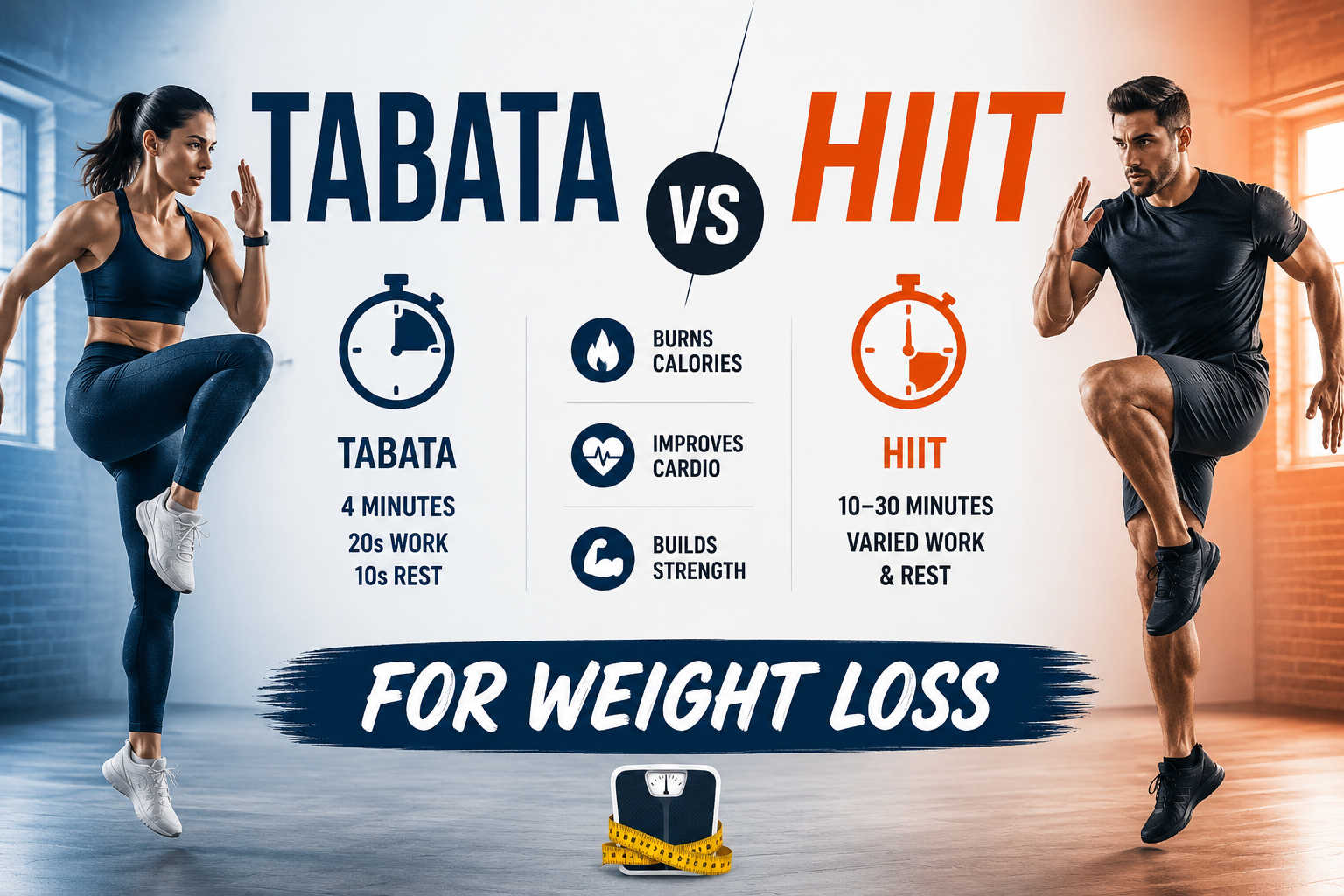
The truth is, Tabata is a type of HIIT. But that one fact actually makes the comparison more interesting, not less. Because once you understand how differently they work inside your body, you will stop guessing and start choosing the workout that actually matches your goals.
Let me walk you through everything — the science, the structure, the fat-burning math, and who should be doing which one in 2026.
What Exactly Is HIIT? (And Why Everyone Defines It Differently)
HIIT stands for High-Intensity Interval Training. At its core, it means alternating between short bursts of intense effort and brief recovery periods.
Here is what trips people up: HIIT is not one workout. It is a category of training.
Think of HIIT the way you think of ‘cardio’. Jogging, swimming, cycling, and dancing are all cardio — but they are very different experiences. Similarly, Tabata, sprint intervals, and circuit training are all forms of HIIT, but they have different structures, intensities, and outcomes.
A typical HIIT session involves:
- Work intervals: 20 seconds to 2 minutes of near-maximum effort
- Rest intervals: 15 seconds to 2 minutes of rest or low-intensity movement
- Total duration: Usually 20 to 40 minutes
- Intensity target: 80–95% of your maximum heart rate
The flexibility is the point. A beginner can do 20 seconds of moderate jumping jacks with 40 seconds of rest. An elite athlete can do 60-second sprints with 30-second rests. Both are technically HIIT.
That flexibility is also why HIIT is so popular in 2026 — it fits any schedule, any fitness level, and almost any goal.
What Is Tabata? The 4-Minute Protocol That Changed Everything
In 1996, Dr. Izumi Tabata — a sports scientist working with Japan’s Olympic speed skating team — published a study that sent shockwaves through the fitness world.
He compared two training groups over six weeks:
- Group 1: did 60 minutes of moderate-intensity cycling five days a week
- Group 2: did eight rounds of 20-second all-out sprints followed by 10 seconds of rest — just 4 minutes total — five days a week
The results stunned everyone. Group 2, despite working out for 56 fewer minutes per session, showed greater improvements in both aerobic and anaerobic capacity than Group 1.
That 4-minute protocol became known as Tabata training. Here is what one round looks like:
| Round | Work Phase | Rest Phase |
| Rounds 1–8 | 20 seconds — maximum effort, every round | 10 seconds |
| Total time | 2 minutes 40 seconds of work | 1 minute 20 seconds of rest |
| Grand total | 4 minutes per round |
Most full Tabata workouts chain four to five of these rounds together — one exercise per round — with one minute of rest between rounds. That gives you a 20–25 minute workout in total.
| The critical difference from regular HIIT: maximum effort is non-negotiable in Tabata. You are not working at 80% or 85% intensity. You are working at 100%. Every single round. The 10-second rest is just long enough to not die — it is not long enough to actually recover. That brutality is the mechanism. |
Tabata vs HIIT: The Core Differences Side by Side
Here is a complete comparison before we get into the science of fat loss:
| Feature | HIIT | Tabata |
| What it is | Broad category of interval training | Specific HIIT protocol — one of many |
| Work interval | 20 sec – 2 minutes (flexible) | Always exactly 20 seconds |
| Rest interval | 15 sec – 2 minutes (flexible) | Always exactly 10 seconds |
| Work:Rest ratio | 1:1 or 1:2 — more recovery time | 2:1 — more work than rest |
| Intensity target | 80–95% of max heart rate | 100% — truly maximum effort |
| Session length | 20–40 minutes | 4 mins per round (16–20 mins total) |
| Best for | Fat loss, endurance, all fitness levels | Power, anaerobic capacity, advanced |
| Flexibility | Very high — adapt intervals freely | Strict — structure never changes |
| Recovery needed | 24–48 hours between sessions | Minimum 48 hours — non-negotiable |
| Weekly sessions | 3–4 sessions per week | 2–3 sessions per week maximum |
The most important row in that table is the work-to-rest ratio. HIIT typically gives you equal or more rest than work. Tabata gives you twice as much work as rest. That single difference separates casual interval training from one of the most demanding protocols in sports science.
The Fat-Burning Science: What the Research Actually Says
This is where things get genuinely interesting — and where a lot of fitness content gets it completely wrong.
How HIIT Burns Fat
HIIT burns fat through two distinct mechanisms:
During the workout: Your body rapidly depletes glycogen (stored carbohydrates) and shifts to burning fat as intensity drops slightly during rest periods. A 25-minute HIIT session can burn 25–30% more calories than the same duration of steady-state cardio, according to multiple studies published in peer-reviewed journals through 2024–2025.
After the workout — EPOC: This is the real magic. EPOC stands for Excess Post-Exercise Oxygen Consumption, also called the afterburn effect. After a HIIT session, your body continues burning calories at an elevated rate for hours — sometimes up to 24–48 hours — as it works to restore oxygen levels, repair muscle tissue, and rebalance your metabolism. Research confirms that HIIT generates significantly higher EPOC than steady-state cardio.
A comprehensive meta-analysis reviewing 18 controlled intervention trials found that HIIT reduces body fat percentage, visceral fat (the dangerous fat around your organs), and waist circumference more effectively than moderate-intensity continuous training — even when total workout time is shorter.
How Tabata Burns Fat (Differently)
Here is where the 2024 research from Frontiers in Endocrinology changes the picture in a meaningful way.
A peer-reviewed study directly compared Tabata, HIIT, and moderate-intensity continuous training in terms of energy expenditure and fat oxidation — both during exercise and during recovery. The findings were striking:
- Tabata group: fat oxidation rate of 0.27 g/min during exercise and recovery
- HIIT group: fat oxidation rate of 0.20 g/min
- Moderate cardio group: fat oxidation rate of 0.20 g/min
| Key finding: Tabata burned fat at a 35% higher rate than traditional HIIT during the recovery window. The energy expenditure rate followed the same pattern — Tabata burned 5.76 kcal/min compared to HIIT’s 4.81 kcal/min. |
A follow-up study published in Scientific Reports in 2025 found that two Tabata cycles performed in a single session maximized fat oxidation in the post-exercise period, suggesting an optimal ‘dose’ for fat loss.
What does this mean in plain terms? Tabata burns fat faster per minute than traditional HIIT — but it is also significantly more demanding. The question is whether you can actually sustain 100% maximum effort for 20 seconds, eight times in a row. If your effort drops below true maximum, you are no longer doing Tabata. You are doing a very short HIIT workout.
Sample Workouts: Exactly What These Look Like in Real Life
Knowing the theory is one thing. Let me show you exactly what these workouts look like when you are actually doing them.
HIIT Workout — Beginner (25 Minutes)
- Warm-up: 5 minutes of light jogging or jumping jacks
- Circuit (3 rounds): 30 seconds work / 30 seconds rest per exercise
| Exercise | Work Time | Rest Time | Rounds |
| Squat Jumps | 30 seconds | 30 seconds | 3 |
| Push-Ups | 30 seconds | 30 seconds | 3 |
| Mountain Climbers | 30 seconds | 30 seconds | 3 |
| High Knees | 30 seconds | 30 seconds | 3 |
| Burpees | 30 seconds | 30 seconds | 3 |
- Rest between rounds: 90 seconds
- Cool-down: 5 minutes of full-body stretching
This is approachable. The 1:1 work-to-rest ratio gives you time to breathe, correct your form, and push hard on the next interval without dreading it.
HIIT Workout — Intermediate (30 Minutes)
| Exercise | Work | Rest | Rounds |
| Jump Squats | 40 seconds | 20 seconds | 4 |
| Push-Up to Shoulder Tap | 40 seconds | 20 seconds | 4 |
| Lateral Bounds | 40 seconds | 20 seconds | 4 |
| Rest between circuits | — | 60 seconds | — |
| Burpees | 40 seconds | 20 seconds | 4 |
| Reverse Lunges | 40 seconds | 20 seconds | 4 |
| Plank Hold | 40 seconds | 20 seconds | 4 |
Tabata Workout — Advanced (20 Minutes)
| Important: A 10-minute warm-up before Tabata is not optional. Going from rest to 100% effort with a cold body is a direct path to injury. Warm up properly every single time. |
| Round | Exercise | Structure | Rest After Round |
| 1 | Burpees | 8 × (20 sec on / 10 sec rest) | 60 seconds |
| 2 | Jump Squats | 8 × (20 sec on / 10 sec rest) | 60 seconds |
| 3 | Mountain Climbers | 8 × (20 sec on / 10 sec rest) | 60 seconds |
| 4 | High Knees | 8 × (20 sec on / 10 sec rest) | Done |
| Reality check: If you finish a round of true Tabata and feel like you could immediately do another at the same intensity, you did not work hard enough. You should feel genuinely spent at the end of each 4-minute round. This is the honest truth that most workout guides won’t tell you. |
Who Should Choose HIIT (And Who Should Not)
HIIT is the right starting point for the vast majority of people. Choose HIIT if:
- You are a beginner. HIIT’s flexible structure lets you control the intensity. Start with 1:2 ratios (30 seconds on, 60 seconds rest) and build from there. Jumping straight into Tabata as a beginner is a fast track to injury or burnout.
- You are recovering from an injury. The adjustable rest periods in HIIT let you manage load more carefully. Your physiotherapist or doctor can help you calibrate appropriate intervals.
- Your goal is general fat loss and cardiovascular health. Multiple studies confirm HIIT delivers excellent fat loss, improved heart health, and better insulin sensitivity across diverse populations.
- You have 20–30 minutes and a normal fitness base. HIIT gives you an outstanding workout in that window without requiring you to operate at your physical ceiling.
- You want variety. HIIT can include running, cycling, swimming, rowing, resistance exercises, or bodyweight movements. Variety dramatically improves long-term adherence — and adherence is what actually produces lasting results.
Who Should Choose Tabata (And When)
Tabata is exceptional — but it has a narrow ideal audience. Choose Tabata if:
- You already have a strong fitness foundation. This means you can sustain high-intensity cardio for 20+ minutes without stopping. If that is not you yet, build up with HIIT first — minimum 6–8 weeks.
- You are genuinely short on time. Four minutes of real Tabata burns roughly the equivalent of 30 minutes of moderate cardio. For professionals with extremely tight schedules, this makes Tabata practically irreplaceable.
- You have hit a plateau with regular HIIT. When your body adapts to standard HIIT, switching to Tabata for 4–6 weeks can shock your metabolism and break through stagnation.
- You are training for sport performance. The simultaneous improvement of both aerobic and anaerobic systems makes Tabata valuable for athletes in sports requiring endurance and explosive power — football, basketball, martial arts, swimming, cycling.
- You enjoy a serious challenge. Some people genuinely thrive under extreme physical demand. If that is you, Tabata will give you more than you bargained for — in the best possible way.
| Critical rule: Do not do Tabata more than 3 times per week. Your body needs 48 hours minimum between true Tabata sessions. Overtraining with Tabata leads to elevated cortisol, muscle breakdown, and fatigue — the opposite of fat loss. |
The Verdict: Which One Is Actually Better for Weight Loss?
Here is the honest answer that most articles will not give you.
For sustained long-term weight loss: HIIT wins
Not because it burns more fat per minute — Tabata does. But because fat loss is a long game. The workout you will actually do consistently for six months beats the theoretically superior workout you quit after three weeks.
HIIT is more adaptable, more accessible, less taxing on recovery, and easier to maintain alongside a busy life. Research consistently shows that people who start HIIT stick with it longer than those who dive into maximum-intensity protocols like Tabata.
For maximum fat burning in minimum time: Tabata wins
The 2024 Frontiers in Endocrinology data makes this clear — Tabata produces higher fat oxidation during and after exercise than traditional HIIT. If you are an experienced exerciser with the fitness level to do it properly, Tabata is an extraordinarily efficient fat-burning tool.
The smartest approach in 2026: combine both
Use HIIT as your primary weekly training tool — 3 to 4 sessions per week. Sprinkle in one Tabata session per week as a high-intensity spike. This approach builds your aerobic base, maintains intensity variety, and prevents the plateau effect that kills so many training programs.
Common Mistakes People Make with Both Workouts
After years of watching clients train, these are the errors I see most often:
Calling every interval workout ‘Tabata’
True Tabata requires 100% maximum effort on every single interval. If you are holding back to make it through all 8 rounds, you are doing HIIT — which is perfectly fine, but call it what it is. The distinction matters because it affects how you plan recovery.
Skipping the warm-up
This is especially dangerous with Tabata, where you go from rest to maximal effort in seconds. Ten minutes of dynamic warm-up is not optional. It is injury prevention.
Doing high-intensity training every day
Your nervous system needs recovery. Three days of Tabata per week with no rest days will lead to overtraining syndrome faster than almost any other training mistake. More is not better. Better is better.
Ignoring nutrition
Both HIIT and Tabata create significant calorie expenditure, but they also increase appetite. Great workouts paired with poor nutrition produce mediocre results. For a full breakdown of how to eat around your training, read our guide on the best diet plan for weight loss.
Prioritising speed over form
High-intensity training with poor form is an injury waiting to happen. If your squat breaks down when you are tired, slow down. Form first, intensity second — always. This is especially true in Tabata where the short rest periods create fatigue rapidly.
Frequently Asked Questions
Is Tabata better than HIIT for weight loss?
Tabata burns fat at a higher rate per minute than traditional HIIT, according to peer-reviewed research from Frontiers in Endocrinology (2024). However, HIIT is generally more sustainable long-term, making it the better choice for most people focused on overall weight loss. The best approach is using HIIT as your foundation and adding Tabata once your fitness base is solid.
Can beginners do Tabata?
Beginners can attempt modified Tabata — starting with lower-intensity exercises like bodyweight squats, high knees, or marching in place. However, true Tabata requires 100% maximum effort, which is risky without a fitness foundation. Most experts recommend 6–8 weeks of HIIT experience before attempting full Tabata protocols.
How many calories does Tabata burn compared to HIIT?
A 4-minute Tabata round burns approximately 13–15 calories during the workout, but the post-exercise afterburn significantly increases total calorie expenditure. A full 20-minute Tabata session can burn 240–360 calories. A 30-minute HIIT session typically burns 300–450 calories, depending on body weight and intensity.
How many times a week should I do Tabata?
No more than 2–3 times per week for Tabata, with at least 48 hours of rest between sessions. Tabata is extremely demanding on your central nervous system. Doing it daily leads to overtraining, elevated cortisol, poor recovery, and diminishing returns rather than fat loss.
Can I do HIIT every day?
It is not recommended. Most fitness experts suggest 3–4 HIIT sessions per week with rest or low-intensity movement days in between. Daily HIIT without adequate recovery leads to overtraining, inflammation, and increased injury risk over time.
What exercises work best for Tabata?
The best Tabata exercises are movements that you can start and stop quickly and that engage large muscle groups. Top choices include burpees, squat jumps, high knees, mountain climbers, push-ups, jump rope, and sprints. Exercises with complex setups do not work well in the 10-second rest window.
Does HIIT build muscle?
HIIT has modest muscle-maintenance benefits, particularly when strength movements are included. However, it is not a substitute for dedicated resistance training if muscle building is your primary goal. HIIT excels at fat loss and cardiovascular conditioning — pair it with weight training for body recomposition.
The Bottom Line
Tabata and HIIT are not rivals. They are teammates — each powerful in its own context.
HIIT is your everyday workhorse: flexible, effective, sustainable, and backed by decades of research confirming its benefits for fat loss, heart health, and metabolic function.
Tabata is your secret weapon: brutally efficient, scientifically validated, and capable of producing results in 4 minutes that most workouts cannot match in 40.
The mistake is choosing one and ignoring the other. The wisdom is knowing when to use each one — and building a training life where both have a place.
Start with HIIT. Get comfortable. Build your base. Then, when you feel ready to test your limits, add Tabata into the mix.
Your future self — leaner, stronger, and more energised — will thank you for the precision.
Ready to fuel your HIIT or Tabata sessions the right way? Read our expert guide on how to lose weight fast for beginners for the complete picture on training, nutrition, and sustainable fat loss in 2026.
Found this helpful? Save it and share it with someone who is stuck choosing between workouts. And explore our Fitness section for more evidence-based training guides.
📌 EDITORIAL POLICY & FACT-CHECK NOTICE
How we write and review our content:
- ✅ Written by certified fitness and nutrition professionals with 15+ years of clinical experience.
- ✅ All health claims are supported by peer-reviewed research from PubMed, NCBI, and established medical journals.
- ✅ Research citations are linked directly within the article text for full transparency.
- ✅ Articles are reviewed and updated regularly to reflect the latest scientific evidence.
- ✅ Content follows Google’s YMYL guidelines and E-E-A-T standards for health and fitness information.
- ✅ We do not accept payment for editorial content. All recommendations are based on evidence and clinical experience.
📅 Last updated: May 2026 | 📚 Sources: See inline citations | ❓ Questions? Contact us