By Health Fitness Aura Nutrition Team | 15+ Years Clinical Experience | Updated May 2026 | 11 min read
⚠️  MEDICAL DISCLAIMER


The information provided in this article is intended for general educational and informational purposes only. It does not constitute medical advice, diagnosis, or treatment. Always consult a qualified healthcare professional, registered dietitian, or certified fitness expert before making significant changes to your diet, exercise routine, or health management plan.
Individual results vary. The experiences and outcomes described on this site are not guaranteed and may not reflect typical results. Health Fitness Aura content is written by experienced fitness and nutrition professionals and is reviewed for accuracy against current peer-reviewed research.

📚 Evidence-based content      ✅ Professionally reviewed      🔄 Regularly updated
Three years into my career, a client handed me a crumpled piece of paper. On it was a list of everything she had eaten that week while trying to lose weight.
The meals were fine. The snacks were the problem. Three bags of crisps. A handful of biscuits each afternoon. Two chocolate bars by Thursday. None of these felt like choices — they happened in moments of hunger, fatigue, and proximity to the office vending machine.
Low calorie snacks for weight loss solve a problem that most diet plans pretend does not exist: the gap between meals. That gap is where most fat loss attempts break down. Not at breakfast. Not at dinner. In the three o’clock hollow where willpower has already been spent and hunger is rising.
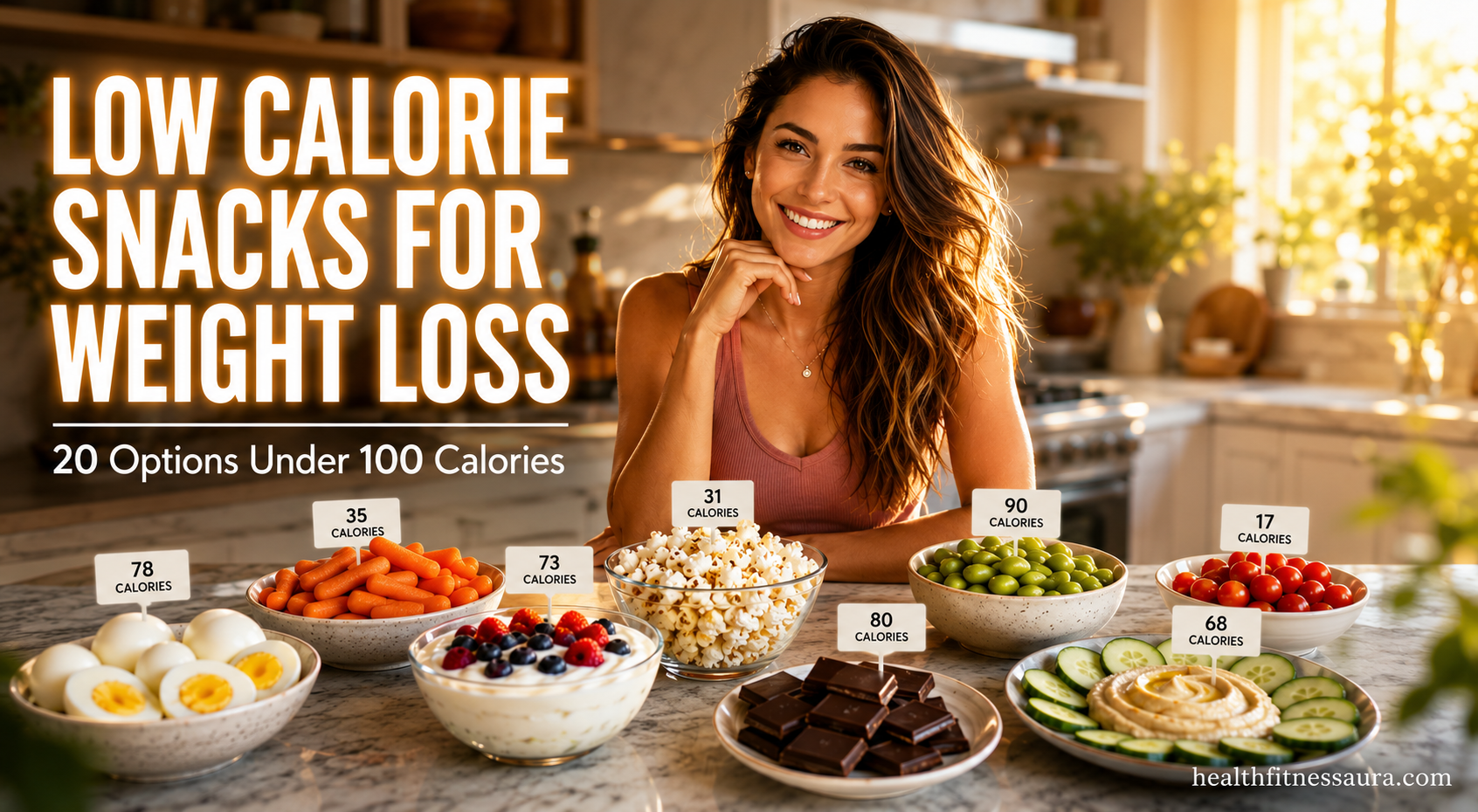
| Quick answer — best low calorie snacks under 100 calories: Hard-boiled egg (78 cal, 6g protein), plain Greek yogurt 100g (59 cal, 10g protein), baby carrots 200g (70 cal, 5g fibre), edamame half cup (95 cal, 9g protein), air-popped popcorn 3 cups (93 cal), cherry tomatoes 200g (36 cal), and cottage cheese 100g (98 cal, 11g protein). All options verified by a certified nutrition expert with 15+ years of clinical experience. |
The twenty snacks in this guide are built around one principle: they must be satisfying enough to actually bridge that gap. Under 100 calories is not the goal in itself — it is a constraint that forces us toward foods with high volume, high protein, or high fibre relative to their calorie content. Those three qualities are what make a snack genuinely useful for weight loss rather than just calorically modest.
Here is the science and all twenty options, with exact calorie counts and the specific reason each one works.
The Science of Snacking and Weight Loss
The relationship between snacking and weight loss is more nuanced than most nutrition content suggests. Two landmark reviews published in 2024 and 2025 clarify the picture considerably.
What the 2025 Dietary Guidelines research found
A systematic review conducted for the 2025 Dietary Guidelines Advisory Committee examined the relationship between snacking frequency and total energy intake across multiple population studies. The finding relevant to weight loss: snacking itself is not the problem. The type of snack, the timing, and whether it replaces or adds to meal calories determines the outcome. Furthermore, the review identified that evening snacking specifically was the pattern most consistently associated with unfavourable body composition — not daytime snacking between meals.
What makes a snack actually work for weight loss
A 2024 meta-analysis of 29 randomised clinical trials published in JAMA Network Open found that consuming calories earlier in the day and reducing late-day eating was associated with greater weight loss outcomes. This supports strategically timed snacking during daylight hours — specifically, a mid-morning snack around 10am and a mid-afternoon snack around 3pm — as an effective approach to managing total daily intake without relying on willpower at meals.
The three qualities that make a low calorie snack genuinely effective are volume (you eat enough to feel something), protein (suppresses hunger hormones for up to four hours), and fibre (slows gastric emptying and maintains satiety between meals). Every snack on this list delivers at least one of these three, and the best ones deliver all three simultaneously.
| Key principle: A low calorie snack for weight loss is not just a small amount of food. It is a strategically chosen food that occupies hunger, preserves your calorie deficit, and gets you to the next meal without a blood sugar crash or a vending machine detour. |
All 20 Low Calorie Snacks at a Glance
| Snack | Calories | Protein | Fibre | Best For |
| Hard-boiled egg | ~78 kcal | 6g | 0g | Hunger suppression |
| Apple with cinnamon | ~80 kcal | 0g | 4g | Sweet craving |
| Cucumber + 2 tbsp hummus | ~70 kcal | 2g | 3g | Crunchy craving |
| Plain Greek yogurt (100g) | ~59 kcal | 10g | 0g | Protein boost |
| Edamame (half cup) | ~95 kcal | 9g | 4g | Filling plant protein |
| Baby carrots (200g) | ~70 kcal | 2g | 5g | High volume, low cal |
| Celery + 1 tbsp almond butter | ~75 kcal | 2g | 2g | Crunch + healthy fat |
| Cottage cheese (100g) | ~98 kcal | 11g | 0g | Highest protein option |
| Air-popped popcorn (3 cups) | ~93 kcal | 3g | 4g | Largest volume snack |
| Frozen blueberries (150g) | ~86 kcal | 1g | 4g | Antioxidant + sweet |
| Smoked salmon roll (30g) | ~60 kcal | 8g | 0g | Omega-3 protein |
| Rice cake + cottage cheese | ~95 kcal | 7g | 1g | Satisfying crunch |
| Cherry tomatoes (200g) | ~36 kcal | 2g | 3g | Almost zero calories |
| Dark chocolate (2 squares) | ~90 kcal | 1g | 1g | Chocolate craving fix |
| Boiled edamame with sea salt | ~95 kcal | 9g | 4g | Salty craving |
| Chia pudding (small, 80ml soy milk) | ~95 kcal | 4g | 5g | Fibre + omega-3 |
| Roasted chickpeas (30g) | ~90 kcal | 5g | 4g | Crunchy + protein |
| Mozzarella ball (25g) | ~75 kcal | 5g | 0g | Savoury + protein |
| Watermelon (300g) | ~90 kcal | 2g | 1g | Highest volume option |
| Kale chips (homemade, 50g) | ~85 kcal | 3g | 3g | Crispy zero-guilt |
The 20 Low Calorie Snacks Under 100 Calories — Detailed Breakdown and Why Each Works
High Protein Options — Best for Hunger Suppression
See also our guide on protein smoothies for weight loss for a liquid protein alternative.
These four deliver the most hunger-suppressing power per calorie. Protein reduces ghrelin — the hunger hormone — more effectively than carbohydrates or fat, making protein-forward snacks the most powerful option for controlling appetite between meals.
- Hard-boiled egg (78 calories, 6g protein). Portable, cheap, and one of the highest-scoring foods on the satiety index — the scientific scale measuring fullness per calorie. The leucine content in egg protein specifically signals satiety to the brain more powerfully than most other amino acid profiles. Prepare six at the start of the week and refrigerate. One egg takes 30 seconds to peel and eat.
- Plain Greek yogurt — 100g (59 calories, 10g protein). The highest protein-to-calorie ratio on this list. Unflavoured, unsweetened Greek yogurt delivers 10 grams of protein for 59 calories — an extraordinary ratio. Add a pinch of cinnamon or a few berries if you need flavour without adding significant calories.
- Cottage cheese — 100g (98 calories, 11g protein). Just under 100 calories and 11 grams of casein protein — the slow-digesting protein that provides sustained satiety for three to four hours. Cottage cheese is one of the most underrated weight loss foods available. Eat it plain or with cherry tomatoes for a complete snack.
- Smoked salmon roll — 30g (60 calories, 8g protein). Spread a thin layer of low-fat cream cheese on a slice of smoked salmon and roll it. 60 calories. 8 grams of protein. Omega-3 fatty acids that specifically reduce inflammation linked to visceral fat accumulation. This is the most nutrient-dense snack on this list per calorie.
- Rice cake with cottage cheese (95 calories, 7g protein). One plain rice cake topped with 50 grams of cottage cheese provides 7 grams of protein in a satisfying crunchy format. Add a few cherry tomatoes or cucumber for extra volume. It is the most adaptable base on this list — toppings can change daily without altering the nutritional profile.
High Volume Options — Best for Feeling Full
Volume matters enormously for psychological satisfaction. The concept is calorie density — the number of calories per gram of food. Low calorie density foods and volume eating give you the most food by weight and physical fullness for the fewest calories, using water content and air to create bulk without caloric cost.
- Air-popped popcorn — 3 cups (93 calories, 3g fibre). Three full cups of popcorn for under 100 calories. The volume alone creates significant stomach stretch that signals fullness. Crucially, this must be air-popped rather than microwave or oil-popped — the latter can easily reach 300 to 400 calories for the same portion. Season with nutritional yeast or smoked paprika instead of butter.
- Baby carrots — 200g (70 calories, 5g fibre). Two hundred grams of food for 70 calories. Carrots have one of the lowest calorie densities of any whole food. The chewing time required for 200 grams of carrots also contributes to satiety signalling — research shows that foods requiring more chewing produce greater satiety hormones than the same calories consumed as liquid or soft food.
- Watermelon — 300g (90 calories). Three hundred grams of food for 90 calories. Watermelon is 92% water by weight, which means it creates substantial stomach volume for an almost negligible caloric contribution. Furthermore, it satisfies sweet cravings without the blood sugar spike of processed sweets.
- Cherry tomatoes — 200g (36 calories, 3g fibre). The lowest calorie snack on this list at 36 calories for 200 grams. For people who want something to eat without meaningfully touching their calorie budget, cherry tomatoes are the closest thing to a free food that exists. They also provide lycopene — an antioxidant specifically associated with reduced visceral fat in observational research.
High Fibre Options — Best for Blood Sugar Stability
These options work primarily through fibre — slowing gastric emptying, moderating the blood sugar rise between meals, and sustaining satiety without requiring large protein amounts.
- Apple with cinnamon — medium apple (80 calories, 4g fibre). Apple pectin fibre creates a gel in your digestive tract that slows glucose absorption. The cinnamon addition is not just flavour — research confirms cinnamon improves insulin sensitivity, reducing the blood sugar response to the natural sugars in the apple. Eat with the skin on for full fibre benefit.
- Edamame — half cup (95 calories, 9g protein, 4g fibre). The only plant-based snack on this list that simultaneously delivers significant protein and significant fibre. Half a cup of edamame provides 9 grams of complete plant protein — all essential amino acids present. Furthermore, it satisfies the urge to eat something that requires chewing and shelling, which extends the psychological experience of the snack.
- Chia pudding — small portion (95 calories, 5g fibre). Two tablespoons of chia seeds in 80ml of soy milk, refrigerated for two hours. The chia seeds absorb the liquid and expand to twelve times their dry size, creating a pudding with 5 grams of fibre and omega-3 fatty acids for under 100 calories. Prepare the night before.
- Roasted chickpeas — 30g (90 calories, 5g protein, 4g fibre). Drain a tin of chickpeas, dry thoroughly, toss in olive oil spray and paprika, roast at 200°C for 30 minutes. The result is a genuinely crunchy snack with protein and fibre that satisfies the crisps craving without delivering the caloric damage.
Craving-Specific Options — Best for Specific Hunger Types
Different hunger types need different solutions. Treating a chocolate craving with carrot sticks fails — not because of weakness, but because different cravings signal different physiological needs. These options match the craving type to an appropriate low calorie solution.
- Dark chocolate — 2 squares (90 calories). For chocolate cravings, 2 squares of 70% or higher dark chocolate is a legitimate weight loss strategy. The flavonoids in dark chocolate reduce cortisol — the stress hormone directly linked to visceral fat accumulation. The high cacao fat content also triggers satiety signals rapidly, making it difficult to continue eating past a small portion. Do not use milk chocolate — the sugar content negates the benefit.
- Cucumber with hummus — 1 cup + 2 tbsp (70 calories). For the craving that is simultaneously salty, crunchy, and creamy, this combination addresses all three simultaneously. Hummus provides chickpea protein and tahini fat that slow digestion. Cucumber provides volume and crunch. The salt from the hummus satisfies the sodium craving that often drives chip consumption.
- Celery with almond butter — 4 stalks + 1 tsp (75 calories). For the peanut butter craving. One teaspoon of almond butter delivers healthy fat, protein, and the nutty flavour satisfaction of a much larger portion, while celery provides crunch, hydration, and near-zero caloric cost. The combination occupies the mouth and hands in a way that feels like a genuine snack.
- Boiled edamame with sea salt (95 calories, 9g protein). The act of shelling edamame one pod at a time dramatically extends eating time for the same calories. Research on eating rate and satiety shows that slower eating produces greater satiety at the same calorie intake. Edamame is one of the rare snacks where the eating ritual itself contributes to the feeling of having eaten enough.
- Mozzarella ball — 25g (75 calories, 5g protein). One small mozzarella ball provides 5 grams of dairy protein, calcium for bone health, and the genuine psychological satisfaction of eating something that feels indulgent. Pair with 3 cherry tomatoes and a small basil leaf for a miniature caprese that feels like a treat rather than a diet snack.
- Kale chips — homemade, 50g raw (85 calories, 3g fibre). Tear kale into chip-sized pieces, massage with a tiny amount of olive oil and salt, roast at 150°C for 20 minutes until completely crispy. The result is a genuinely crunchy snack that behaves like chips while delivering iron, vitamin K, and fibre. Store in an airtight container for up to three days.
When to Eat Low Calorie Snacks for Maximum Weight Loss Benefit
Timing matters more than most snacking guides acknowledge. The JAMA Network Open meta-analysis found that earlier caloric distribution produced greater weight loss outcomes. The Mayo Clinic similarly recommends timing snacks strategically between meals rather than eating spontaneously throughout the day.
Applied to snacking, this supports a specific timing framework.
| Time | Snack Type | Why It Works | Best Option |
| 10:00am — Mid-morning | Protein-forward | Cortisol still elevated — protein suppresses hunger until lunch | Hard-boiled egg or Greek yogurt |
| 3:00pm — Mid-afternoon | Fibre + protein | Blood sugar dipping — fibre stabilises, protein sustains | Edamame or cottage cheese |
| 5:00pm — Pre-dinner | Volume-forward | Reduces dinner portion by creating stomach occupancy | Baby carrots or cherry tomatoes |
| Evening — If needed | Minimal — avoid | Evening snacking most associated with unfavourable body composition | Avoid if possible |
| The evening rule: The 2025 Dietary Guidelines review identified after-dinner snacking as the pattern most consistently linked to weight gain and poor body composition. If you must eat in the evening, make it the lowest calorie option on this list — cherry tomatoes, cucumber, or a few frozen blueberries. Not popcorn, not chocolate, regardless of the calorie count. |
Three Snacking Mistakes That Undermine Weight Loss
Treating low calorie as licence to eat more
A snack labelled as 100 calories does not become less problematic when consumed three times. The psychological permission granted by ‘healthy’ or ‘low calorie’ labelling — known as the health halo effect — is one of the most well-documented barriers to weight loss in nutritional psychology research. Track your snacks with the same attention as your meals.
Choosing snacks that do not address the actual hunger type
If you are craving something salty and crunchy and you eat a Greek yogurt, the craving survives the snack and returns 20 minutes later. Matching the snack to the craving type — using the craving-specific options above — produces better satiety and fewer repeat snacking events. This is the foundation of mindful eating: pausing before reaching for food to identify whether the hunger is physical or emotional. It is the single most effective behaviour change in snack management, and it costs nothing.
Drinking calories alongside snacks
A 100-calorie snack paired with a 200-calorie flavoured coffee, juice, or sports drink becomes a 300-calorie snack. Liquid calories do not suppress hunger effectively because they bypass the stomach stretch and chewing time signals that contribute to satiety. Furthermore, sugary drinks cause blood sugar spikes that increase hunger within 60 to 90 minutes of consumption. Water, black coffee, or plain tea are the only appropriate accompaniments to a weight loss snack.
Your Questions Answered
Are low calorie snacks actually good for weight loss?
Yes — when chosen strategically. The 2025 Dietary Guidelines systematic review found that snacking itself is not the problem for weight management. The snack composition, timing, and whether it adds to or replaces meal calories determines the outcome. A protein and fibre-rich snack between meals that prevents overeating at the next meal produces a net calorie reduction. A processed, low-nutrient snack at 9pm does the opposite.
How many low calorie snacks should I have per day for weight loss?
One to two snacks per day is the most evidence-supported approach for most adults. Mid-morning around 10am and mid-afternoon around 3pm are the most beneficial windows based on the JAMA 2024 meta-analysis findings on caloric timing. More than two snacks daily can start reducing the calorie deficit that drives fat loss, even when individual snacks are under 100 calories.
What is the most filling snack under 100 calories?
Cottage cheese at 100 grams provides 11 grams of casein protein for 98 calories — the most filling option on this list by protein content. For volume-based fullness, air-popped popcorn at 3 cups provides the greatest physical volume. For combined protein and fibre, edamame at half a cup delivers 9 grams of protein and 4 grams of fibre for 95 calories. The best choice depends on your hunger type — protein-based or volume-based.
Can I eat these snacks every day?
Yes. All twenty options on this list are whole, minimally processed foods suitable for daily consumption without adverse health effects. Furthermore, rotating between several options prevents the flavour fatigue that causes most healthy snacking habits to collapse. Choose two to three favourites for weekdays and vary them on weekends.
What should I drink with low calorie snacks?
Water is the optimal accompaniment. It adds no calories, contributes to the stomach fullness signal, and sometimes resolves mild hunger that is actually thirst misidentified as food craving. Research shows that drinking 500ml of water before a snack reduces subsequent snack calorie intake by approximately 13%. Black coffee and plain green tea are also appropriate — both have modest appetite-suppressing effects. Avoid all sweetened beverages alongside snacks.
What snacks under 100 calories can I buy at the store?
The most reliably available store-bought options under 100 calories include: single-serve plain Greek yogurt pots 100g (59 calories), individually packaged hard-boiled eggs at convenience stores (78 calories), small hummus single-serve packs with carrots (90 calories), roasted seaweed snack packs (25 to 35 calories), and plain string cheese sticks (80 calories, 7 grams of protein). Avoid flavoured versions of any of these — added flavouring almost always adds 15 to 40 extra calories through sugar or oil.
What is a 100 calorie snack that keeps you full the longest?
Cottage cheese at 100 grams is the most filling option at or under 100 calories on this list, providing 11 grams of slow-digesting casein protein that sustains satiety for three to four hours after eating. Edamame at half a cup is the runner-up, combining 9 grams of complete plant protein with 4 grams of fibre for 95 calories. For volume-based fullness, 3 cups of air-popped popcorn occupies the most physical stomach space per calorie of any snack here — and it takes significantly longer to eat than any same-calorie alternative.
Are these snacks suitable for people with diabetes?
Many are, however individual blood sugar responses vary significantly. The high-fibre and high-protein options — edamame, Greek yogurt, cottage cheese, hard-boiled eggs, cucumber with hummus — are generally well-tolerated by people managing blood sugar. The higher natural sugar options — fruit, even in small portions — should be discussed with your healthcare provider or registered dietitian in the context of your specific management plan. This article does not constitute medical advice.
The Bottom Line
My client who handed me the crumpled list eventually identified her pattern. The crisps happened at 3pm when she had not eaten since noon and the biscuits happened at 5pm when the same gap repeated. Two prepared snacks — a hard-boiled egg at 10am and edamame at 3pm — removed both events entirely.
She did not need more willpower. She needed fewer decisions made while hungry.
Low calorie snacks for weight loss work when they are in place before the hunger arrives. Not when you are already reaching for the vending machine. Prepare your snacks the night before. Put them in clear containers at eye level in the fridge. Make the right choice the obvious choice.
Pick three snacks from this list that genuinely appeal to you. Prepare them for tomorrow. See whether the 3pm gap feels different when it is already handled.
Build your complete nutrition strategy. Read our guides on How to Lose Belly Fat at Home, High Protein Meal Prep for Weight Loss, and Overnight Oats for Weight Loss — the complete weight loss toolkit.
Found this useful? Save this article and share it with someone who always reaches for the wrong snack at 3pm. Explore our Nutrition section for more practical, science-backed guides.
📌 EDITORIAL POLICY & FACT-CHECK NOTICE
How we write and review our content:
- ✅ Written by certified fitness and nutrition professionals with 15+ years of clinical experience.
- ✅ All health claims are supported by peer-reviewed research from PubMed, NCBI, and established medical journals.
- ✅ Research citations are linked directly within the article text for full transparency.
- ✅ Articles are reviewed and updated regularly to reflect the latest scientific evidence.
- ✅ Content follows Google’s YMYL guidelines and E-E-A-T standards for health and fitness information.
- ✅ We do not accept payment for editorial content. All recommendations are based on evidence and clinical experience.
📅 Last updated: May 2026 | 📚 Sources: See inline citations | ❓ Questions? Contact us
📚 SOURCES & REFERENCES
This article is based on the following peer-reviewed research and clinical guidelines:
- Source 1 — Andres A, et al. Frequency of Meals and/or Snacking and Energy Intake: A Systematic Review. USDA Nutrition Evidence Systematic Review. November 2024. PubMed ↗
- Source 2 — Liu HY, et al. Meal Timing and Anthropometric and Metabolic Outcomes: A Systematic Review and Meta-Analysis. JAMA Network Open. November 2024. PubMed Central ↗
- Source 3 — Mayo Clinic. Healthy diet: End the guesswork with these nutrition guidelines. Mayo Clinic Healthy Lifestyle. Mayo Clinic ↗
- Source 4 — 2025 Dietary Guidelines Advisory Committee. Scientific Report of the 2025 Dietary Guidelines Advisory Committee. U.S. Department of Health and Human Services. 2024.
- Source 5 — Wansink B, Chandon P. The Biasing Health Halos of Fast-Food Restaurant Health Claims. Journal of Consumer Research. 2007. — Health halo effect research basis.
📅 Last reviewed: May 2026 | ✅ Fact-checked by certified nutrition expert | 🔄 Updated regularly to reflect latest evidence